What actually happens when agencies acquire: lessons from Re:signal’s acquisition of Root Digital
M&A
What actually happens when agencies acquire: lessons from Re:signal’s acquisition of Root Digital
Agency acquisitions are often talked about in terms of strategy, valuation and market opportunity. Those things matter. But the reality of getting a deal done is usually more human, more fluid and more operational than the headline suggests.
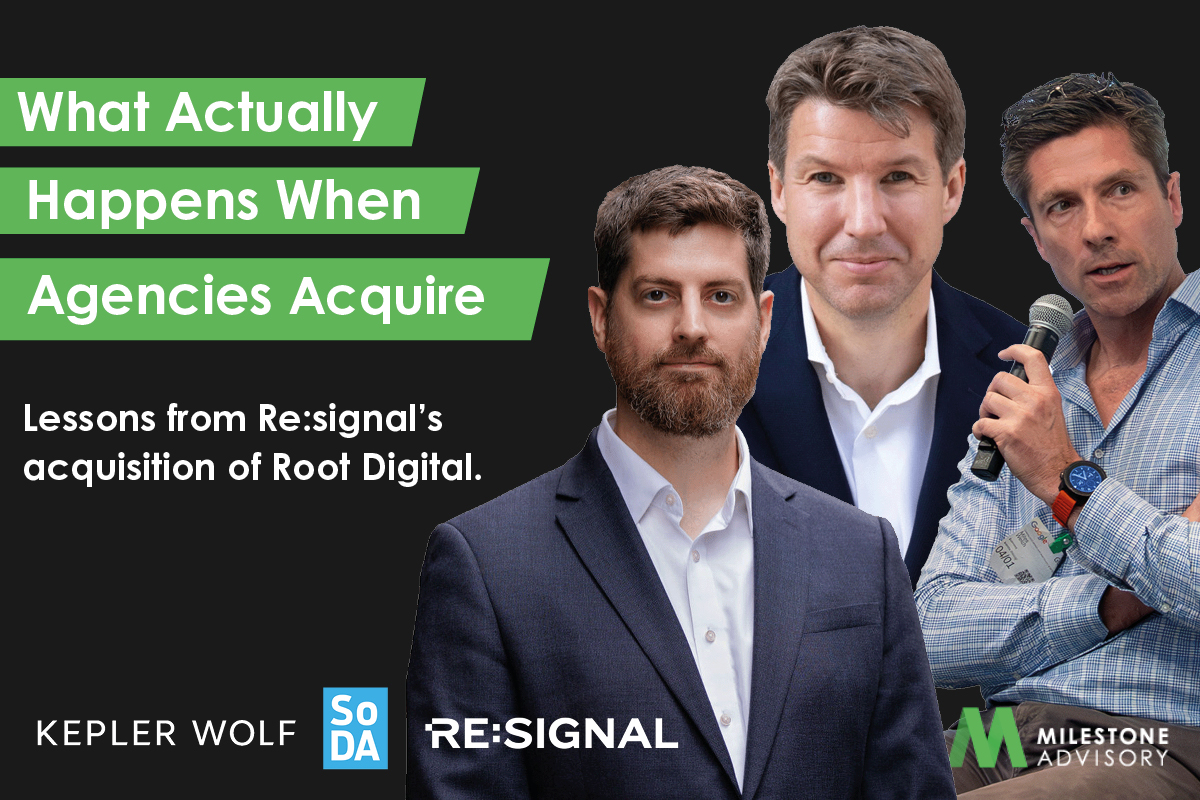
That was one of the strongest themes from our recent conversation with Kevin Gibbons, Founder and CEO of Re:signal, and John Haggis, lawyer and Founder of law firm Kepler Wolf, reflecting on Re:signal’s acquisition of Root Digital.
Milestone Advisory supported Re:signal through the transaction, advising on the acquisition and helping bring together two highly complementary agencies: Re:signal, with its deep expertise in technical SEO and organic growth, and Root Digital, known for high-impact digital PR and content-led campaigns.
The deal was strategically compelling. Re:signal’s clients increasingly needed technical SEO, content and digital PR working together as search, AI discovery and online reputation become more connected. Root added exactly that creative PR capability.
But one of the most interesting points from the discussion was that the strategic rationale is only the starting point. Making an acquisition work requires much more than spotting an obvious fit.
You can acquire without private equity backing
One of the most useful lessons from the Re:signal/ Root deal is that acquisitions are not only for large agency networks or PE-backed platforms.
This transaction was self-funded. That matters because many agency founders assume acquisition is out of reach unless they have raised external capital, taken on significant debt, or already operate at scale.
The Re:signal example shows that the right acquisition can be approached differently. If there is a clear strategic rationale, a sensible deal structure, strong leadership and enough conviction on both sides, an independent agency can use M&A as a practical growth lever.
For agency founders, that is an important mindset shift. Acquisition does not have to mean becoming financial-engineering-led. It can be a deliberate, strategic way to accelerate capability, strengthen market positioning and respond to what clients are already asking for.
The business you start buying is not always the business you complete on
Kevin made a point that will resonate with anyone who has run an agency: agency businesses are always moving.
People join. People leave. Clients change. New opportunities appear. Existing projects evolve. Even over a six-month deal process, the business you are assessing at the start may not look exactly the same by completion.
That does not mean something has gone wrong. It is simply the nature of acquiring a people-based business.
The key is to expect movement, not be surprised by it. Buyers need to understand that agency M&A is not the same as buying a static asset. You are buying client relationships, capability, culture, reputation, leadership and future potential. All of those things need careful handling.
This is also why communication matters. A deal can quickly become “us and them” if every point is forced through advisers. The best processes keep two threads open: the commercial and personal relationship between buyer and seller, and the adviser-led detail around legal, financial and commercial points.
Both are needed. One builds trust. The other protects the deal.
Management distraction is real
Another practical insight was the amount of time involved.
Buying or selling an agency is not a side project. It creates additional workload, pressure and decision-making at exactly the point when the business still needs to perform.
That is why a strong team beneath the founder or leadership group is so important as well as the advisor taking the heavy lifting. If the business can only operate effectively when the founder is fully present every day, a transaction process will expose that dependency very quickly.
For buyers, this matters because they need confidence that the business can keep trading while the deal is being negotiated.
For sellers, it matters because performance drift during a process can weaken confidence, create deal friction and affect value.
In many ways, a transaction tests the operating maturity of the agency. It shows whether the business has enough management depth, reporting discipline and leadership capacity to handle pressure without losing momentum.
Earnouts are about alignment, not just deferred payment
Agency transactions often involve earnouts because buyers won’t be comfortable paying 100% of the consideration on day one, when future performance depends on people, clients and continued growth. You need an incentive for people to stay and help continue to build the business - and earnouts or deferred payments can be a key one which helps de risk the deal for a buyer if they do decide to leave prematurely after completion, as well as enabling the buyer to fund the acquisition over time.
That creates a natural tension.
The seller wants enough protection and commercial flexibility to feel they can influence the outcome and achieve the earnout. The buyer needs enough control, visibility and integration rights to manage the business properly and deliver the rationale for the acquisition.
Good deal structures recognise both sides.
An earn-out should not just be treated as deferred consideration. It is a mechanism for alignment. If it is badly designed, it can create frustration and mistrust. If it is well structured, it can help both sides stay focused on the same commercial outcome.
This is where experienced legal and M&A advice becomes important. Not because the documents are the deal, but because the documents need to reflect the commercial intent clearly enough to avoid unnecessary disputes later.
Integration starts before completion
One of the most common mistakes in agency M&A is treating integration as something that begins after the deal is signed.
In reality, integration thinking starts much earlier.
How will the teams work together? How quickly should the businesses be brought closer? What needs to remain distinct? How will clients experience the combined offer? What language will people use internally? Which processes need to align?
The Re:signal/ Root deal had a clear strategic logic: bringing together SEO, content and digital PR to create a stronger organic growth proposition for eCommerce and consumer brands. But turning that logic into a functioning business requires careful integration.
Sometimes the right answer is to move slowly and let the acquired business continue independently. Sometimes a faster integration plan is better for the long-term health of the group. The point is not that one model is always right. The point is that the decision should be deliberate.
The real validation comes when the combined business starts to win work it could not have won separately. That is when the acquisition rationale moves from boardroom theory to commercial proof.
The best deals are built on trust and evidence
The Re:signal/ Root transaction is a useful example because it was not simply about buying revenue. It was about building a more complete proposition around how brands are now found, trusted and chosen online.
It also showed that successful agency acquisitions require a blend of strategic clarity and practical execution.
You need a reason to do the deal. You need the right target. You need a structure that works for both sides. You need trust between buyer and seller. You need advisers who can handle difficult points without damaging the relationship. And you need a plan for what happens after completion.
At Milestone, that is where we spend much of our time: helping founders and leadership teams think beyond the transaction itself.
A signed deal is important. But the real benchmark of success is whether the combined business is stronger, more valuable and better positioned after the deal than it was before.
That is what good M&A should achieve.